Physics before graphics
Instead of focusing on a photorealistic cockpit, the simulator visualizes the engineering principles that determine whether a helicopter can safely operate near the summit of Everest.
Educational engineering simulator visualizing the physics of helicopter operations at extreme altitude. Not a traditional flight simulator, but an interactive exploration of power limits, aerodynamics, and decision-making near the edge of helicopter performance. In 2005, Didier Delsalle became the first pilot in history to land a helicopter on the summit of Mount Everest. This project was inspired by that remarkable achievement—not to recreate the flight with absolute historical accuracy, but to explore the engineering challenges that made it possible.
Interface preview
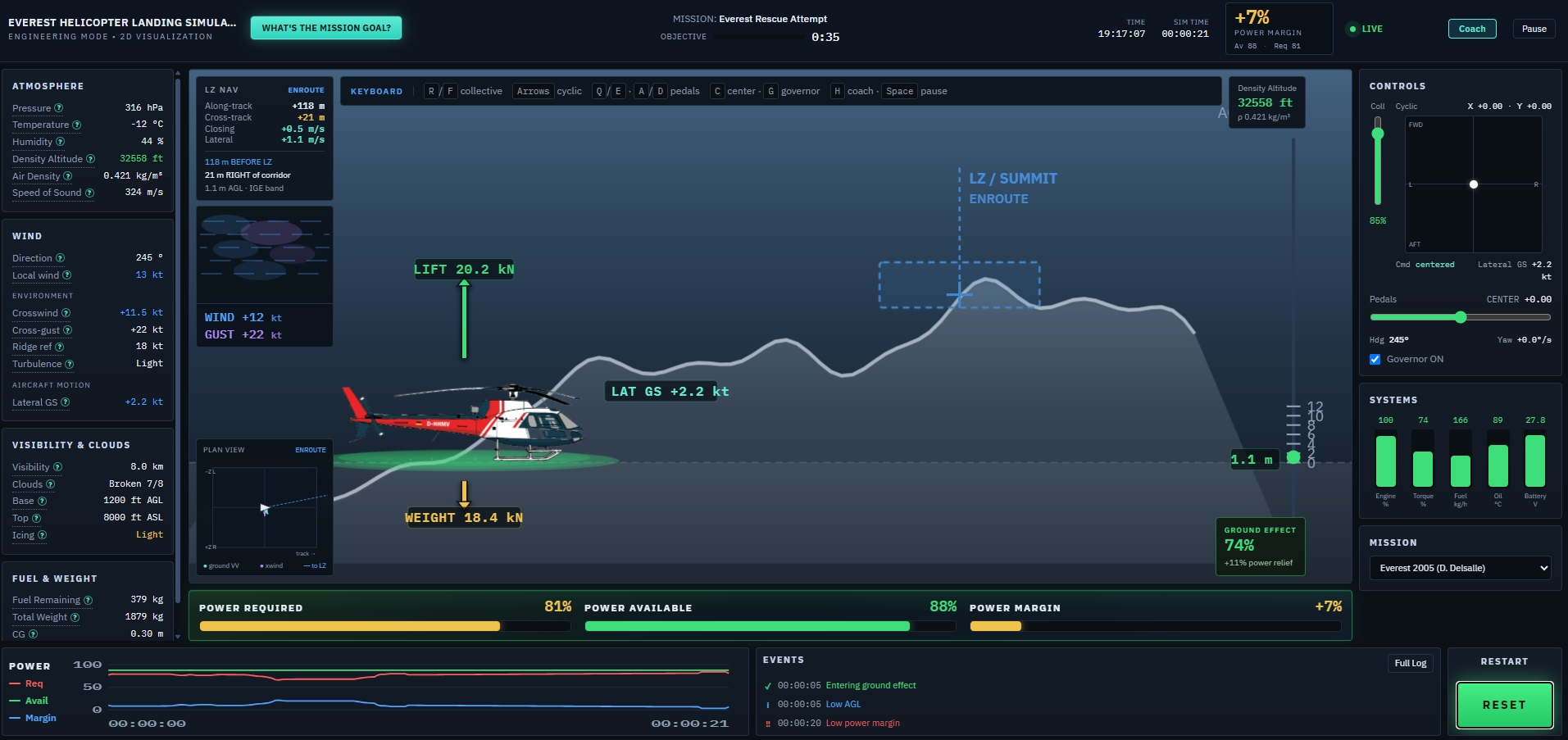
A look at the project in real use.
Value
Instead of focusing on a photorealistic cockpit, the simulator visualizes the engineering principles that determine whether a helicopter can safely operate near the summit of Everest.
Every control input immediately affects lift, power margin, ground effect, crosswind drift, and rotor performance, helping users understand the relationship between pilot actions and aircraft behavior.
Every mission can be replayed with a synchronized event timeline, allowing users to analyze exactly why a landing succeeded or failed.
A contextual coaching mode guides beginners with real-time control suggestions, making complex helicopter dynamics approachable without simplifying the underlying physics.
Audience
Aviation enthusiasts curious about high-altitude helicopter operations
Students learning aerodynamics and flight mechanics
Engineers interested in simulation and data visualization
Recruiters looking for examples of complex frontend architecture 😄
Explore the simulator and experience how thin air, mountain winds, and limited engine power change every decision.